'Til Death Do Us Part
Bobby Curley thallium poisoning by wife Joann Curley
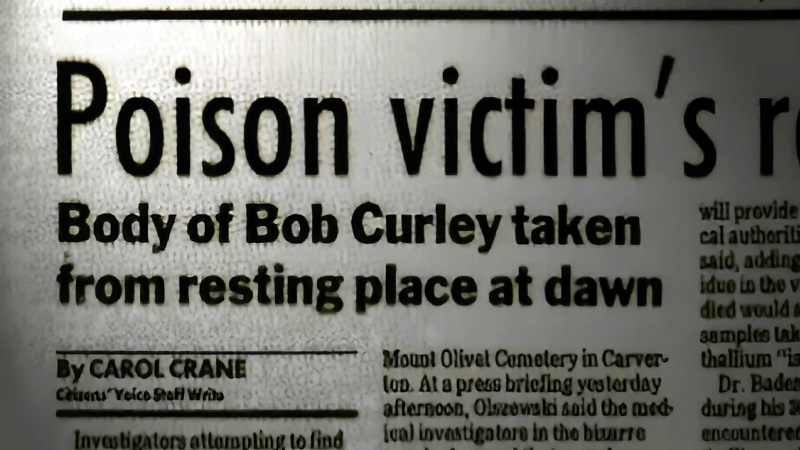
Bobby Curley’s worsening symptoms first pointed doctors toward disease, not poison. But when thallium was found on his thermoses, suspicion shifted to his wife.
Original air date: November 10, 1999
Posted: March 24, 2026
By: Robert S.
Season 4, Episode 6
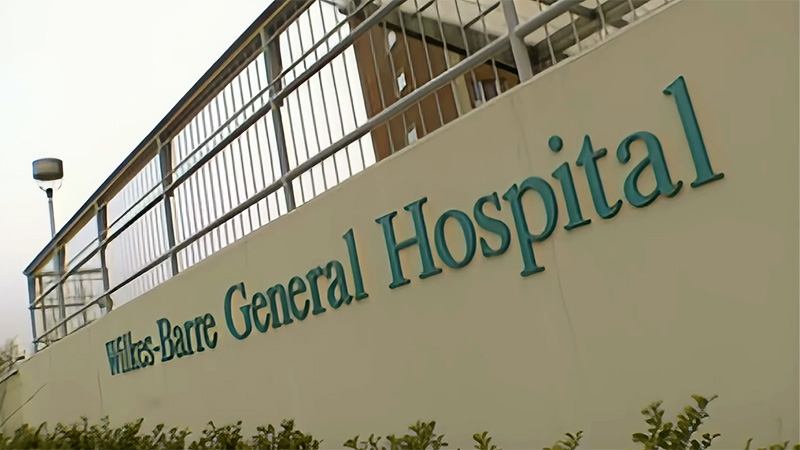
One evening in Wilkes-Barre, Bobby Curley met his older brother David for a drink. But their evening was cut short. Just one beer into their get-together, Bobby complained of not feeling well. He told David his feet were hurting – Bobby described a burning numbness, and it hurt to walk. This was concerning enough that Bobby went to the local hospital.
Doctors at Wilkes-Barre Hospital investigated Bobby Curley's case, and he was diagnosed with Guillain-Barré syndrome. Time in the hospital saw Bobby improve, and he was sent home. But before long, the pain in his extremities returned, and a new symptom now had Bobby vomiting. The Curley family decided more serious measures were required, so Bobby was taken to a regional medical center about 100 miles away.
By the time doctors there saw Bobby Curley, his case had become extreme. He was hallucinating and required restraint for his own safety and that of the staff. The battery of standard blood tests did not give doctors any clues as to the cause of Bobby's condition. But they did notice a symptom that may have gone overlooked before – Bobby Curley was losing his hair.
Coupling the numbness in the extremities with rapid hair loss was enough for Dr. J. Ward Donovan to suspect heavy metal poisoning – either arsenic or thallium. A confirmatory urine test proved that Bobby Curley had been exposed to dangerous amounts of thallium – a constituent of rat poison until the 1960s.
It is rare that someone consumes poison by accident, but Bobby's situation was unique. He was the foreman electrician running a crew at an abandoned chemistry laboratory. And among the dangerous chemicals still scattered about was thallium. So police called the Occupational Safety and Health Administration to examine the workplace for thallium contamination.
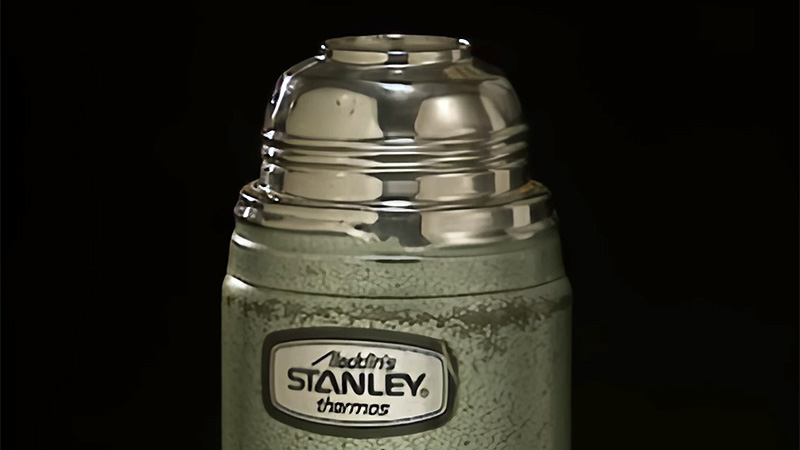
Meanwhile, back at home, police searched the Curley house for contamination as well. And instead of finding it on the discarded cabinets Bobby had claimed and brought home, trace amounts of thallium was found on his thermos. Two of them, to be exact. Bobby's exposure was now seeming less and less like an accident.

The Facts
Case Type: Crime
Crime
- Murder
Date & Location
- October, 1990 through September 27, 1991
- Wilkes-Barre, Pennsylvania
Victim
- Bobby Curley (Age: 32)
Perpetrator
- Joann Curley (Age: 28)
Weapon
- Poison: Thallium
Watch Forensic Files: Season 4, Episode 6
'Til Death Do Us Part
The Evidence
Forensic Evidence
- Report: Toxicology
Forensic Tools/Techniques
- Atomic absorption spectrophotometry
Usual Suspects
No Evil Geniuses Here ?
- None occurred in this episode
Cringeworthy Crime Jargon ?
- None uttered in this episode
File This Under... ?
- Body exhumed
The Experts
Forensic Experts
- Fredric Reiders, Ph.D.: Forensic Toxicologist
Quotable Quotes
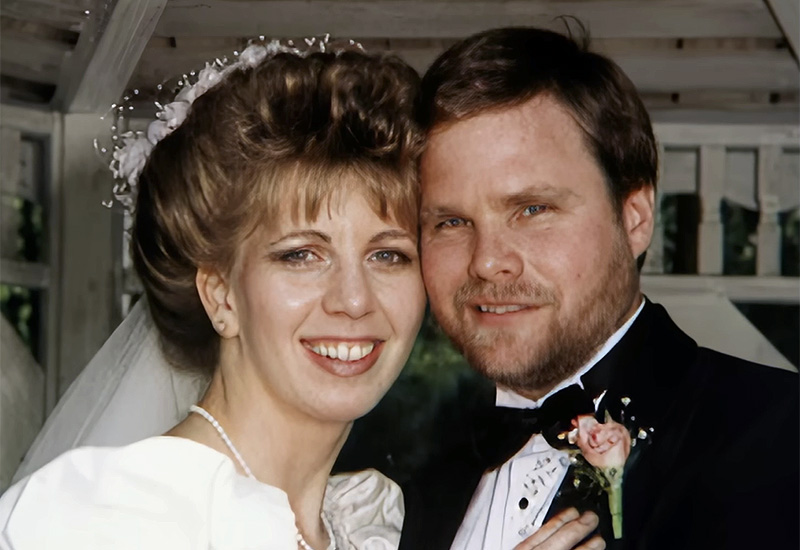
- "They had a beautiful wedding. Bob really wanted to meet a nice girl, and start a family, and just enjoy life. And he said he really loved her, and I was happy for Bob." - Susan Hooper: Bobby Curley's Sister
- "I thought maybe at one point that he would get better, but he never did. He got worse and worse – he couldn’t sit, he couldn’t lay, he couldn’t do – everything was bothering him." - Mary Curley: Bobby Curley’s Mother
- "I did not know who placed the thallium in the iced tea containers. I could not confirm that, but I think that somebody certainly did, and that caused his death, and homicide is one person causing the death of another." - Graham S. Hetrick: Coroner
- "This was an investigation of exclusion – eliminating people that could not have done it until you got down to the one person left who had to have done it – which was Joann." - Robert McBride: Criminal Investigator
- "And that her confession paralleled it [the timeline of Bobby’s poisoning] … frankly, I was amazed. I wasn’t proud or delighted, you know it was good, but I was amazed." - Fredric Rieders, Ph.D. : Forensic Toxicologist
- "Unbelievable. Married two months, and you start killing you husband. And the last one [poisoning], that’s the one that really bothered me. That he got it while he was in the hospital." - David Curley: Bobby Curley's Brother
Last Words
The reenactments in Forensic Files, over its 14-year history, are usually strong. They add an element to the storytelling that other series don't bring, and they are generally tastefully executed. From the smart blend of overt and implied violence to the actors' resemblance to the actual participants, scenes from these reenactments often enhance an episode's narrative. Let's not forget the brilliant portrayal of George Hansen in Frozen Assets (s13e01).
But we must comment here on the fake beard worn by the actor in Bobby Curley's role. Perhaps there was a casting mix-up, or an actor with a better beard became ill. But pasting a silly fake beard onto this chap was more comical than intended. He looked like Dwight Schrute's special brother Mose (Michael Schur) from The Office. But as soon as we get to hear Peter Thomas say, "Atomic absorption spectrophotometry," all is forgiven.
While I don't know the specific pacing of a typical episode, the trial and resolution in this one stood out to me. Often, cases are being wrapped up and sentences shared around the 18-minute mark. This allows room for a round-up of the events and final commentary. This episode had a convicted Joann walking with police escort before the 16-minute point. The remaining few minutes were stretched with commentary and many of the black-and-white reenactment scenes.
Joann + Bobby Curley (and Joann's settlement money)
A timeline of the Bobby Curley murder, including Joann's past, puts things into sharper perspective regarding her motivation.
- 1987: Joann Chopack's daughter Angela is born
- 4/1988: Joann's first husband (John Chopack) dies in an auto accident
- 9/1989: Joann and Bobby Curley begin dating
- 8/11/1990: Joann and Bobby wed
- 10/1990: Joann begins poisoning Bobby
- 5/1991: Bobby's crew starts at the chemistry lab
- 8/1991: Bobby's symptoms start to appear
- 9/25/1991: The $1.7 million settlement is reached
- 9/27/1991: Bobby Curley dies from acute thallium poisoning
What the episode didn't cover was the parallel event chain going on before and during Joann and Bobby's marriage. It was indeed a tragic accident that took John Chopack's life. A trucking company was found to be at fault, and the process of reaching a responsible settlement began.
As these things take years, various stages of this process were probably both known and unknown to Bobby. Whether he knew that the target value of the settlement was nearing two million dollars is unknown. But it was likely apparent to Joann that a settlement was going to be reached. Perhaps she didn't want to share it with Bobby once she knew it had reached $1.7 million.
And there is likely no coincidence in the fact that it took only 48 hours from the time the settlement was finalized to Joann's coup de grâce. She began poisoning Bobby in October 1990. At some point, one can believe she had a grim realization – a potentially large settlement was coming, she did not want to share it with the man she had just married, and she had found old rat poison in her grandmother's basement.
The chemistry lab angle
Though it ultimately played no role in Bobby's exposure, the episode's exploration of the chemistry laboratory as the source was intriguing. It was the luckiest stroke Joann could have asked for, but she failed to cash in on her fortune. The state of a building when various contractors are brought in to perform their various functions always varies. As a telephone contractor in the 90s, I worked quite a few buildings, mostly new construction (which has its own hazards). In 1996-7, we did an unoccupied, five-floor hospital that was transitioning to an assisted living facility. But by the time they requested our team's services, the place was pristine.
The anecdotal feedback was interesting, especially Chet Purta's description of the "Touch me and die" thallium rag. That is pretty darn specific in a giant chemistry lab with any number of potentially dangerous chemicals. Would there ever have been a reason for such a rag to exist? It suggests lazy chemists wiping up clumsy spills of solutions containing deadly heavy metals. And then these Keystone Chemists choose to label such a rag instead of properly disposing of it. That's just too hard to buy.
Susan A. Shovlin was a classy interview. I loved her style and her knowledge. If your job title is Industrial Hygienist, you're pretty much a badass. And this was her role working for the Occupational Safety and Health Administration (OSHA).
It was said that Curley was the butt, among other people, of practical jokes. Hot pepper in chewing tobacco was shared as an example. I've known a few sketchy electricians over the years. Even the dumbest contractor or jokester isn't going to dose anyone with Valium, and then somehow mistake it for thallium.
Bobby's symptoms and diagnoses
Bobby's original diagnosis with Guillain-Barré syndrome (GBS) missed the mark. It makes one wonder how close doctors were to catching the poisoning and saving Bobby in August 1991. The hair loss acknowledged in his subsequent hospitalization was supposedly a signal of heavy metal poisoning, whether arsenic or thallium. Greater attention to the pain in Bobby's feet, more than the numbness, might have supported a poisoning diagnosis as well.
Had Bobby shown up to the hospital now, more than 35 years later, with the same symptoms, how would the examination and diagnosis go? Would today's doctors, inheriting an ever-growing body of knowledge and the ubiquity of data access, stop exploring at GBS? Do modern investigative lab panels include additional, more deductive indicators now? Thallium is treatable, but only if detected early enough to prevent neurological damage.
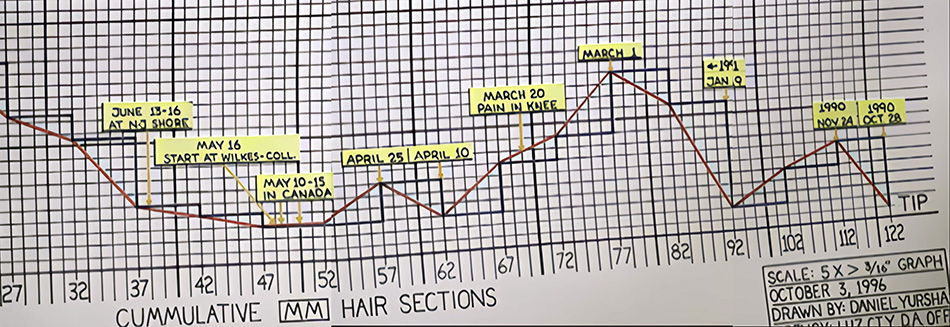
By beginning to poison Bobby slowly in late 1990, did Joann inadvertently help him build up a tolerance? Bobby was given low enough doses to remain asymptomatic for almost ten months. Joann spiked Bob's iced tea with rat poison "about a dozen times." She wasn't too methodical in either periodicity or dosage if her goal was to end Bobby's life. Perhaps she was concerned that, if she increased the dosage too rapidly, Bobby would detect the doping and grow suspicious.
While writing this, I was proud to (almost) pull the name "Debbie Pignataro" from memory. This lovely lady was the victim of her narcissistic husband's methodical, prolonged poisoning. In the episode Bad Medicine (s09e08), Dr. Anthony Pignataro, inventor of the snap-on toupee, poisons his wife Deborah with arsenic over a period of months. And Penchant for Poison (s10e33) sees Lita Noble slowly poisoned by confidant Tim Scoggins. But Lita was a tough lady, and instead of succumbing to the arsenic, she really did build up a tolerance.
Joann's (mis)fortune, Bobby's bad luck
As suggested earlier, Joann was handed the coincidence that her husband's company was rehabilitating a chemistry lab that exposed her otherwise unaware husband to thallium. But despite this, she had one plan, and she worked it over and over, without results, for nearly a year. Maybe learning of his exposure was her impetus to increase Bobby's dosage, now that a blamable source had been identified. Had this not been the case, there would have been a tighter list of suspects, and it may not have taken five years to convict Joann.
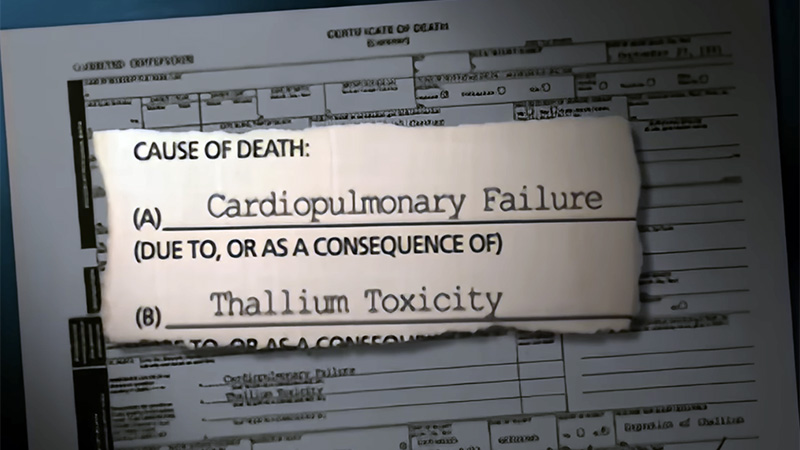
I'm sure no family wishes to exhume their loved one's body. This led me to wonder why Bobby had been buried so rapidly. If his demise was questioned even a little, it would make sense to retain the cadaver for its evidentiary value. Dr. Fredric Rieders' findings of high levels of arsenic in Bobby Curley's digestive tract occurred post-exhumation. I think without the discovery of the lethal dose, Joann would have been caught anyway. But she sealed her fate with the final, lethal dose.
I was also wondering about Bobby's $300k life insurance policy. In 1991, that was worth far more than the figure sounds like now. When I was a single man, I had my measly policy through work. Certainly not enough to be worth killing a man, me, for. As a married man, my demise would have left my wife with a mortgage and one income, so I bought life insurance: enough to cover the mortgage, and a little more, with a term matching the mortgage. A safety net.
So why was Bobby sporting a $300k policy? Recall it was he who moved into Joann's house, and he still made her the sole beneficiary of his policy. Perhaps Joann's daughter and the merging of a new father figure played into it. But a policy that large, especially if Bobby carried it while single, seems abnormal.
The episode shared that both Joann and daughter Angela were tested for and found to have been exposed to thallium. This was a minute amount, insignificant when compared to Bobby's. But, the mother's and daughter's exposure occurred after Bobby's death. This implies that police had already searched the Curley house, found the contaminated thermoses, and "cleared" the home. So despite post-conviction interviews where Joann denies dosing herself and her daughter, there really is no other explanation.
A Few Final Notes
Some of Bobby's symptoms described in the early episode were triggering for me. After a 2015 brain operation and prior to his death, my dad experienced a couple bouts with hallucinations and had to be restrained. I was grateful to be with my sister, to talk about rational things in an irrational situation.
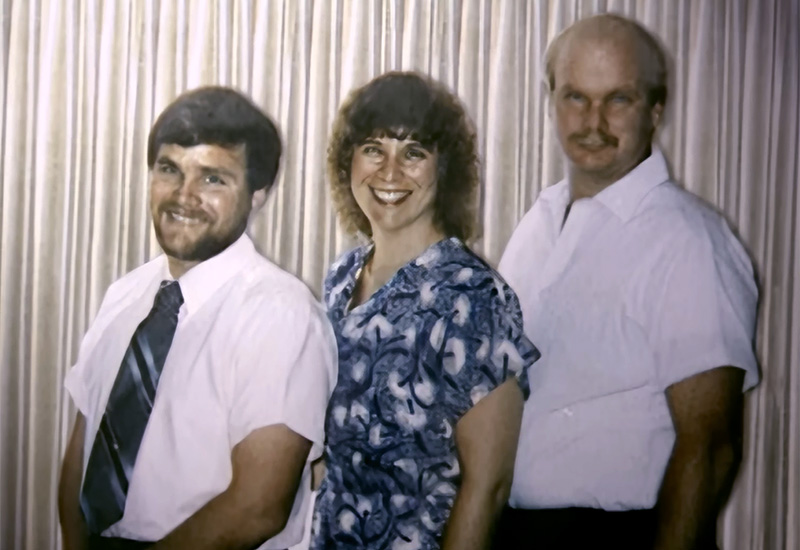
John Chopack, Joann's first husband, was killed in April 1988. Bobby Curley moved into his new wife's home shortly after their wedding. I can't imagine the heartbreak (probably more so for Angela; who knows how blackened Joann's heart already was) that one goes through when losing a spouse, or a father as a young child. But moving into the previously shared home would, to me, feel like trying to occupy a space, to fill a hole in their world. It would feel like "stepping in" instead of "starting anew". I hazard to guess the newlyweds were in Joann and John's bedroom, possibly even in the same marital bed.
Bobby's lovely sister, Susan Hooper, was appalled by Joann's willingness – her wanting to "see Bob die." While I can't speak to Joann's motives with certainty, I will suggest that different people react differently to extreme situations. And a few people act very differently. Investigations, including those on Forensic Files, often quip about the suspect who "doesn't react correctly" to certain revelations. That judgment is subjective and speculative at best. You don't know someone's background, nor their history with persons related in the case.
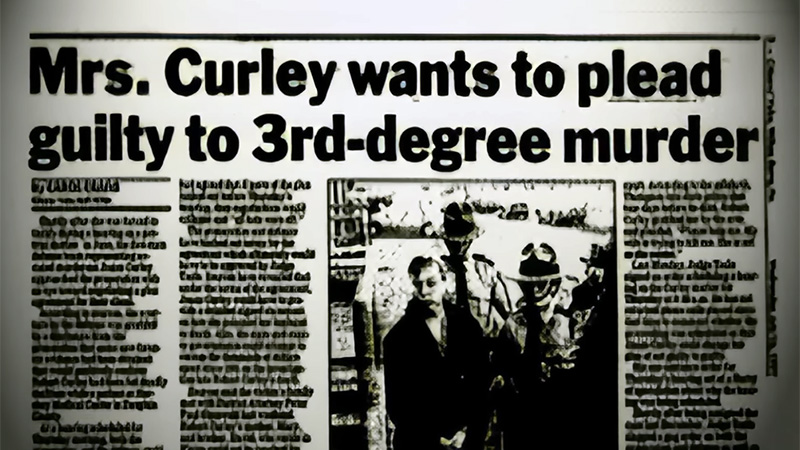
Until I read more about the sentencing, I was aghast that Joann received just "10-20 years in a state prison." How a clearly first-degree murder slipped to third and netted the assailant a maximum of 20 years for the extended, arduous torture of her own husband was outrageous. Outrageous! But the Curley family was afraid that Joann might not be convicted, so they compromised, as many families do, to get a semblance of justice and peace. In turn, Joann had to confess to the murder and describe her motive.
Apparently, Joann was able to receive the bulk of Bobby Curley's life insurance policy of $300k. This went to pay for her lawyers in her criminal defense. But if found guilty, which she was, can the insurance company revoke that payout? Demand Joann return the $300k since she murdered their policyholder?
Where is Joann Curley now in 2026?

The plea deal accepted by the state and Bobby's family during sentencing in 1997 saw Joann Curley receive a sentence of 10 to 20 years in Pennsylvania State prison. Custodianship of Joann's daughter Angela, nine years old at the time, was given to then-boyfriend Alan Gurnari. The Curley family fought each attempt at early release, including getting a new victims' rights law passed under then Pennsylvania governor Tom Corbett. Every attempt – nearly ten in total – for early release was denied. Finally in December 2016, Joann Curley was released from the State Correctional Institute at Cambridge Springs, near Erie. Joann was 53 at the time of her release, making her 63 years old now in 2026.
Find a typo or issue with the details of this case? Leave a comment below, or contact us!