Step by Step
Steven Lucas murder of mother Bette Lucas in Tyler, Texas
Tyler, Texas socialite Bette Lucas suffers a fatal accident in her home. But impossible physics and a son's betrayal reveal a murder and cover-up.
Original air date: March 28, 2007
Posted: February 23, 2026
By: Robert S.
Season 11, Episode 37
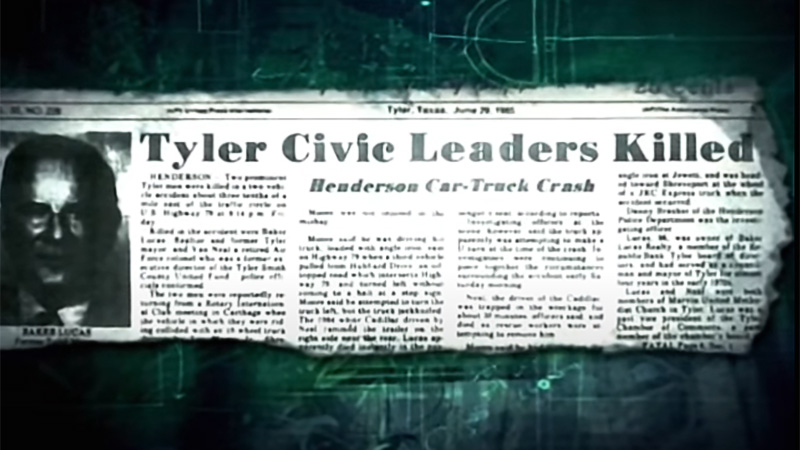
The Lucas family grew into an institution in Tyler, Texas. The patriarch, Baker Lucas, ran a business that saw countless Tyler residents as his home-buying customers. By the 1970s, Baker had amassed a small fortune and was elected mayor of Tyler for nearly the entire decade. His wife, Bette Lucas, played her role alongside him, and with Baker's help the Lucas family became known for their generosity. Bette was even referred to as the "First Lady of Tyler."
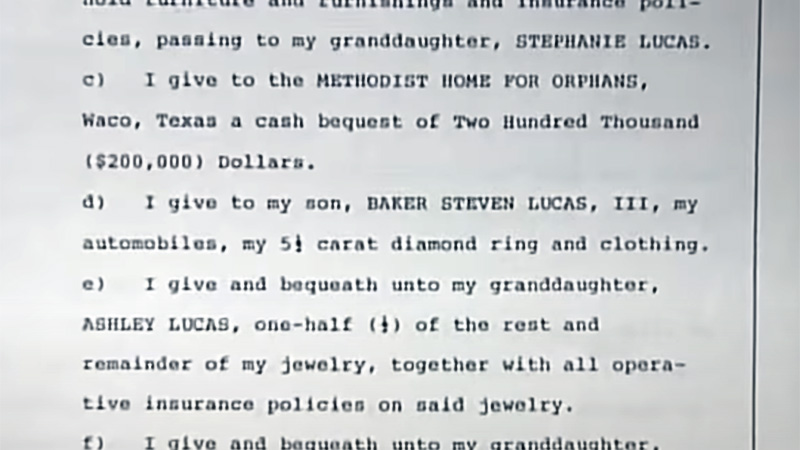
Fortune turned for the Lucases in 1985 when Baker was killed in a tragic car accident. Baker "Steven" Lucas, the couple's only son, tried stepping into his father's rather large shoes. Without his father's charisma, Steven didn't excel at maintaining the family's wealth after his father's death. The business's failures were a particular sore spot for Bette. Her son had already borrowed nearly a half-million dollars and gave no indication of paying it back. Bette Lucas began reconsidering her will — and her son Steven as its sole beneficiary.

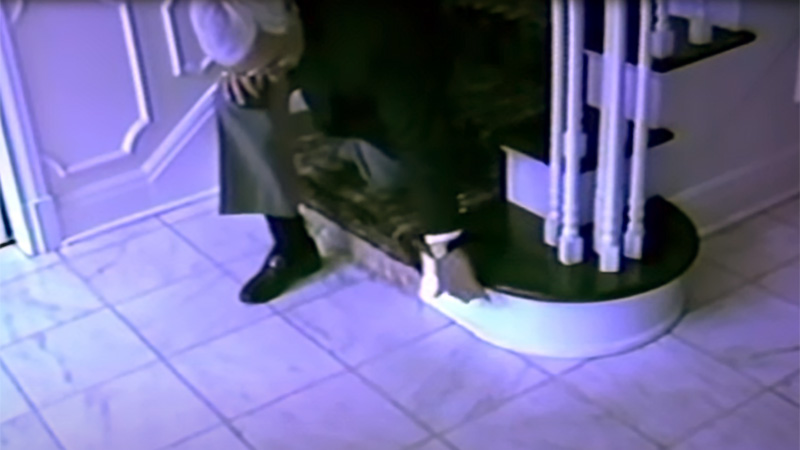
Then, on a late evening in June, paramedics were summoned to the Lucas estate. Steven Lucas was waiting outside as the medics approached. His mother had apparently fallen down the foyer stairway, but Steven wasn't attending to her. EMS soon learned Bette's accident was no ordinary spill down a staircase. Instead, she had supposedly hurled herself — accidentally — over the second-floor railing, seriously injuring her head on the stairs below.
Bette Lucas was rushed to the hospital. She survived briefly with the aid of life support, but it was soon determined that her condition offered no hope of recovery. Bette Lucas died on June 6, 1988. Her son Steven inexplicably organized the funeral and burial for the very next day. It didn't take long for suspicion to grow among friends, neighbors, and family. Before long, police received multiple anonymous phone calls urging them to investigate further into the accidental death of Bette Lucas.
A judge ordered Bette's body exhumed for a forensic autopsy. In addition to the known injuries from her supposed fall, her head revealed a half-dozen curvilinear impact wounds — the type and shape that had no business being on the back of her head if this were truly a fall injury. The mysterious injuries weren't the only elements out of place. Physical damage to the stairway railing and banister proved inconsistent with a fall over the railing.
For three years, police built their case against Steven. Between the forensic evidence and the physics of the crime scene itself, the district attorney believed a conviction was clear-cut. But in 1991, the case against Steven Lucas proved unconvincing to a jury, and a mistrial was declared. With an 8-4 split, would the evidence ever be enough to convince twelve jurors of Steven's role in his mother's death?

The Facts
Case Type: Crime
Crime
- Murder
Date & Location
- June 5, 1988
- Tyler, Texas
Victim
- Bette Lucas (Age: 66)
Perpetrator
- Baker "Steven" Lucas (Age: 46)
Weapon
- None found or used in this episode
Watch Forensic Files: Season 11, Episode 37
Step by Step
The Evidence
Forensic Evidence
- Pattern injury: Victim
- Reconstruction: Accident
- Report: Autopsy
- Report: Toxicology
Forensic Tools/Techniques
- Forensic animation
- Forensic photography
- Leucomalachite green
Usual Suspects
No Evil Geniuses Here ?
- Scene staging: Unconvincing accident evidence
Cringeworthy Crime Jargon ?
- None uttered in this episode
File This Under... ?
- Body exhumed
The Experts
Forensic Experts
- Alan Weckerling: Accident Reconstructionist
Quotable Quotes
- "In fairness to Steve, his father was such a charismatic, well-liked person that it would be very difficult for him to step fully into his father’s shoes. I think that probably this is something that was not lost on him, and he attempted to manage the business, but not as well as Baker had." - David Dobbs: Prosecutor
- "We received several anonymous calls at the police department telling us that we needed to investigate the death of Bette Lucas. That it really was not an accident, and perhaps it was a homicide. " - Connie J. Castle: Crime Scene Investigator
- "And the fact that they brought her back out of the ground, and that was hard to take too. But we were happy that they did if they were going to find some proof of what’ve happened." - June Jones: Bette’s Friend
- "Three of us went up and down that first flight of stairs, on our hands and knees, and with laser lights looking for tears, blood, fibers, anything on that runner and that carpet or anything on the carpet or on the post that held up that handrailing that would’ve been out of place." - Danny Alexander: Homicide Detective (Ret.)
- "Bette’s hairdresser, Patsy Denman, told the authorities that Bette had told her in that in the days leading up to the murder that she was very fed up with Steve’s inability to hold a job and to represent the family well, and that she was going to cut him out of the will, and she was going to tell him about it." - David Dobbs: Prosecutor
- "He was borrowing money from family friends and failing to pay that back. Banks had threatened to foreclose on him. And he was reaching desperation point where it was all going to come tumbling down." - Vanessa Curry: Former Reporter, Tyler Morning Telegraph
Last Words
My heart goes out to June Jones, Bette’s long-time friend. When she described how she and Bette envisioned their future lives, enjoying their retirement home together, it was sad. Bette was only 66 years old when she was killed. That’s a lot of life left to live. Even the Forensic Files interview with Ms. Jones showed her continued vibrance and sadness. June must have been a close friend to Bette Lucas after the 1985 death of the Lucas family patriarch, Baker.
The rushed burial and destroyed evidence
The chain of events between Bette Lucas being taken to the hospital in early June 1988 and her untimely death on the 6th is sketchy at best. Reportedly on life support for “at least a day,” Bette was likely brain damaged beyond any reasonable chance of recovery. Multiple blows to the skull will do that.
Seemingly at Steven’s directive, his mother was removed from life support. Bette Lucas was interred the next day in what felt to most like a hurried funeral. If this was an attempt to preserve some notion of dignity, it failed. Her body was later exhumed for a court-ordered forensic analysis. Steven apparently believed law enforcement might halt their investigation if the victim’s body was no longer accessible.
As if the next-day burial was not suspicious enough, the actions of his adult daughter were inexplicable.
Let’s describe the space between the attack on Bette and the arrival of paramedics. If my mother (or grandmother) fell down the stairs, I would be on the phone immediately. Full stop.
Even if medics took ten minutes to arrive (which seems doubtful in Tyler, Texas, in 1988), the idea of “cleaning up” would never cross my mind. Clean up the blood? Why? Seriously, why?
Stephanie Lucas was culpable in her grandmother’s murder by helping destroy evidence at the scene. There are zero rational, innocent people who would believe that cleaning up blood was imperative.
Motive: money, resentment, and inheritance
Stephanie’s motivation to help her father Steven cover up her grandmother’s murder likely included inheritance. After watching her father sponge off of his parents for years, she may have seen the Lucas fortune as a pathway to luxury and ease. Her father had always tried taking the easy way. That fits.
Steven, however, was obviously not cut from the same cloth as his father, Baker. Perhaps, at least in Bette’s mind, no one could live up to the standards Baker achieved. How hard Steven truly tried is ultimately unknown.
It is easy to imagine a negative cycle of trying, failing to please someone, and growing resentful after repeated rejection. Maybe Steven earnestly attempted to manage his father’s estate and business but lacked the necessary skills. Instead of building his confidence, perhaps his mother’s criticism made him bitter. Over the three years between his father’s car accident and his mother’s murder, that resentment may have grown into motive.
Trial one: The physics the jury found a way to ignore
Time to talk physics.
The proper physics comes from my high school AP Physics class taught by Mr. Patch in Marblehead, Massachusetts. Steven Lucas’ first trial was underway when I graduated from Marblehead High School with an “A” in that class.
Gravity is constant.
For most people with a high school education that included physics, that three-word statement alone should be enough to explain why the defense’s version of events could not have occurred. But since it was not enough for one-third of a jury in 1991, I will continue.
Gravity operates on all objects. All objects, always.
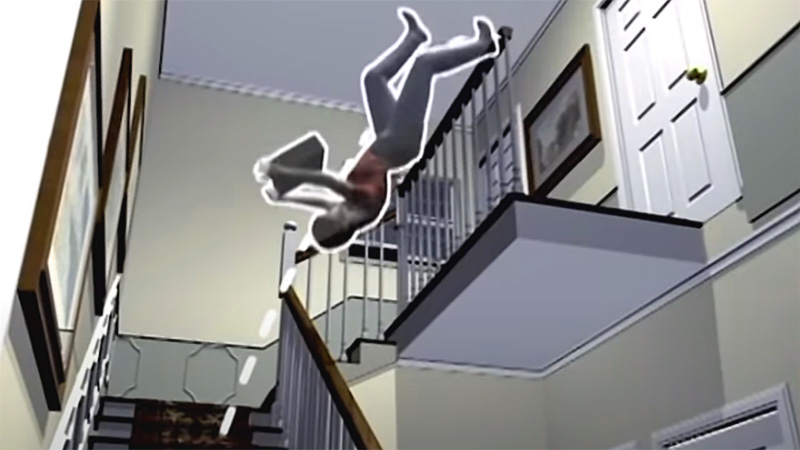
If a woman holding a 32-pound VCR crests a banister railing with horizontal momentum, she and the VCR are immediately accelerated earthward at 32 feet per second per second. Now imagine her just over the railing, possessing some horizontal velocity but subject to a fixed vertical acceleration.
Add time to that thought experiment.
According to the defense, Bette’s body and the VCR cleared the three-foot gap between the railing and the staircase below. They even cleared the outer railing of the lower staircase. Knowing how quickly she was being pulled downward, how fast would her body (and the VCR) have to be traveling horizontally to land where the defense claimed she did?
I remain flummoxed that a full third of a jury appeared willing to believe that a woman and her VCR could, in effect, fly.
This explanation should have been sufficient to send twelve intelligent jurors into deliberation with clarity. Yet in 1991, four people apparently thought, “Well, maybe… maybe she launched herself with tremendous force.” At 66 years old.
Even if Steven had physically thrown her over the railing, she still would not have landed where the defense suggested.
The defense’s animation quietly revealed something telling. The depicted pathway was not perfectly parallel to the staircase below. It appeared to loop slightly around a corner. That adjustment would shorten the horizontal distance. But it creates a new problem. It would place her closer to the base of the lower staircase, not aligned with the steps where the railing and banister were damaged.
And VCRs do not create curvilinear impressions, unless they have rounded feet.
From mistrial to conviction
After a week of deliberation and an 8–4 split, the first trial ended in mistrial. Dobbs and the prosecution failed to convince four Texans that math and science matter. At the taxpayers’ expense, the boulder was pushed back up the hill, and three years later the case was tried again.
Steven’s guilt was worth the effort. But it should not have required a do-over.
In the second trial, the prosecution shifted focus toward the forensic pathology. That strategy proved decisive. Perhaps jury selection was more thorough as well.
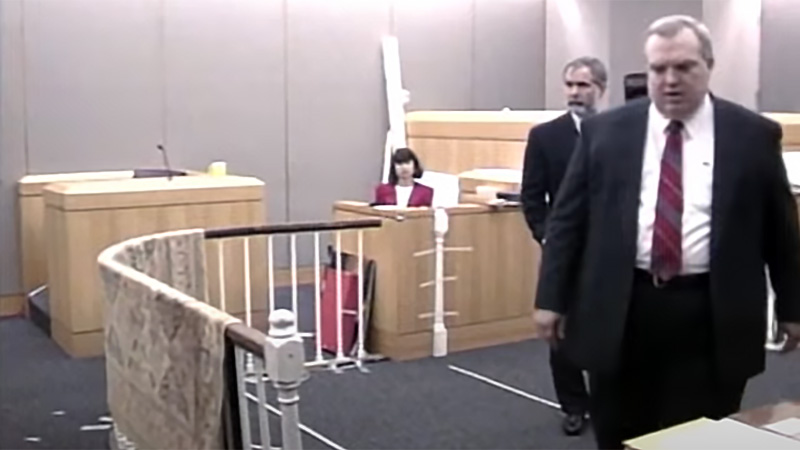
Footage from the second trial showed participants maneuvering around a full-scale model of the Lucas foyer constructed inside the courtroom. The railing height and stairway distances were clearly marked. The model became a visible reminder of the physical constraints the evidence described.
Thirty-three inches, the railing height, is higher than the center of gravity of a five-foot-five-inch woman. And three feet is a long way to travel horizontally while gravity is aggressively pulling you downward.
I appreciated the sentiment, if not the significance, of some of the anecdotal testimony.
“Bette would never carry something heavy.”
I have known older women. I have known stubborn women. For a moment, I would not put it past Bette to grab that VCR and march up the stairs simply to make a point to her deadbeat son Steven. That is the only portion of the defense narrative I find remotely plausible.
“She wouldn’t carry something heavy wearing a long nightgown.”
Prosecutor David Dobbs described a single scenario in which a person might not see her feet and trip on her own gown. This is weak. Nightgowns come in a variety of lengths, and a sophisticated woman like Bette would know how to carry an object without tripping over herself.
“She talked about telling Steve she’d be cutting him from her will.”
Whether she verbalized it or not, this is hearsay about a private intention. Steven likely suspected his mother was reconsidering her will. But if she changed it, to whom? Steven stood to inherit an estate valued at roughly $4 million in 1988. Who else was realistically in contention?
Where is Steven Lucas now now in 2026?
Baker “Steven” Lucas III is serving a 35-year sentence for the June 1988 murder of his mother, Bette Calvert Lucas. He was convicted in his second murder trial in Dallas, Texas, in November 1994, after his first trial in Tyler ended in a mistrial in 1991 when jurors could not reach a verdict. Steven Lucas is 81 years old in now in 2026.
Find a typo or issue with the details of this case? Leave a comment below, or contact us!